5% rabatt bruk koden KMNO5 ved kassen
- Choose your Country

5% rabatt bruk koden KMNO5 ved kassen
Winslow Homer
Winslow Homer was born in Boston, Massachusetts in 1836, Homer was the second of three sons of Charles Savage Homer and Henrietta Benson Homer, both from long lines of New Englanders. His mother was a gifted amateur watercolorist and Homer’s first teacher, and she and her son had a close relationship throughout their lives. Homer took on many of her traits, including her quiet, strong-willed, terse, sociable nature; her dry sense of humor; and her artistic talent.
Homer had a happy childhood, growing up mostly in then rural Cambridge, Massachusetts. He was an average student, but his art talent was on display early. Homer’s father was a volatile, restless businessman who was always looking to «make a killing». When Homer was thirteen, Charles gave up the hardware store business to seek a fortune in the California gold rush. When that failed, Charles left his family and went to Europe to raise capital for other get-rich-quick schemes that didn’t materialize.
After Homer’s high school graduation, his father saw an ad in the newspaper and arranged for an apprenticeship. Homer’s apprenticeship to a Boston commercial lithographer at the age of 19, was a formative but «treadmill experience». He worked repetitively on sheet music covers and other commercial work for two years. By 1857, his freelance career was underway after he turned down an offer to join the staff of Harper’s Weekly. «From the time I took my nose off that lithographic stone», Homer later stated, «I have had no master, and never shall have any.»
Homer’s career as an illustrator lasted nearly twenty years. He contributed to magazines such as Ballou’s Pictorial and Harper’s Weekly, at a time when the market for illustrations was growing rapidly, and when fads and fashions were changing quickly. His early works, mostly commercial engravings of urban and country social scenes, are characterized by clean outlines, simplified forms, dramatic contrast of light and dark, and lively figure groupings – qualities that remained important throughout his career. His quick success was mostly due to this strong understanding of graphic design and also to the adaptability of his designs to wood engraving.
In 1859, he opened a studio in the Tenth Street Studio Building in New York City, the artistic and publishing capital of the United States. Until 1863 he attended classes at the National Academy of Design, and studied briefly with Frederic Rondel, who taught him the basics of painting. In only about a year of self-training, Homer was producing excellent oil work. His mother tried to raise family funds to send him to Europe for further study but instead Harper’s sent Homer to the front lines of the American Civil War (1861 – 1865), where he sketched battle scenes and camp life, the quiet moments as well as the murderous ones. His initial sketches were of the camp, commanders, and army of the famous Union officer, Major General George B. McClellan, at the banks of the Potomac River in October, 1861.
Although the drawings did not get much attention at the time, they mark Homer’s expanding skills from illustrator to painter. Like with his urban scenes, Homer also illustrated women during war time, and showed the effects of the war on the home front. The war work was dangerous and exhausting. Back at his studio, however, Homer would regain his strength and re-focus his artistic vision. He set to work on a series of war-related paintings based on his sketches, among them Sharpshooter on Picket Duty (1862), Home, Sweet Home (1863), and Prisoners from the Front (1866). He exhibited Home, Home, Sweet Home at the National Academy and its remarkable critical reception resulted in its quick sale and in the artist being elected an Associate Academician, then a full Academician in 1865. After the war, Homer turned his attention primarily to scenes of childhood and young women, reflecting his own, and the country’s, nostaglia for simpler times.
At nearly the beginning of his painting career, the twenty-seven year old Homer demonstrated a maturity of feeling, depth of perception, and mastery of technique which was immediately recognized. His realism was objective, true to nature, and emotionally controlled. One critic wrote, «Winslow Homer is one of those few young artists who make a decided impression of their power with their very first contributions to the Academy…He at this moment wields a better pencil, models better, colors better, than many whom, were it not improper, we could mention as regular contributors to the Academy.» And of Home, Sweet Home specifically, «There is no clap-trap about it. The delicacy and strength of emotion which reign throughout this little picture are not surpassed in the whole exhibition.» «It is a work of real feeling, soldiers in camp listening to the evening band, and thinking of the wives and darlings far away. There is no strained effect in it, no sentimentality, but a hearty, homely actuality, broadly, freely, and simply worked out.»
Back in the U.S. in November 1882, Homer showed his English watercolors in New York. Critics noticed the change in style at once, «He is a very different Homer from the one we knew in days gone by», now his pictures «touch a far higher plane…They are works of High Art.» Homer’s women were no longer «dolls who flaunt their millinery» but «sturdy, fearless, fit wives and mothers of men» who are fully capable of enduring the forces and vagaries of nature along side their men.
In 1883, Homer moved to Prout’s Neck, Maine (in Scarborough) and lived at his family’s estate in the remodeled carriage house just seventy-five feet from the ocean. During the rest of the mid-1880’s, Homer painted his monumental sea scenes. In Undertow (1886), depicting the dramatic rescue of two female bathers by two male lifeguards, Homer’s figures «have the weight and authority of classical figures». In Eight Bells (1886), two sailors carefully take their bearings on deck, calmly appraising their position and by extension, their relationship with the sea; they are confident in their seamanship but respectful of the forces before them. Other notable paintings among these dramatic struggle-with-nature images are Banks Fisherman, The Gulf Stream, Rum Cay, Mending the Nets, and Searchlight, Harbor Entrance, Santiago de Cuba. Some of these he repeated as etchings.
At fifty years of age, Homer had become a «Yankee Robinson Crusoe, cloistered on his art island» and «a hermit with a brush». These paintings established Homer, as the New York Evening Post wrote, «in a place by himself as the most original and one of the strongest of American painters.» But despite his critical recognition, Homer’s work never achieved the popularity of traditional Salon pictures or of the flattering portraits by John Singer Sargent. Many of the sea pictures took years to sell and «Undertow» only earned him $400.
In these years, Homer received emotional sustenance primarily from his mother, brother Charles, and sister-in-law Martha («Mattie»). After his mother’s death, Homer became a «parent» for his aging but domineering father and Mattie became his closest female intimate. In the winters of 1884-5, Homer ventured to warmer locations in Florida, Cuba, and the Bahamas, and did a series of watercolors as part of a commission for Century Magazine. He replaced the turbulent green storm-tossed sea of Proust’s Neck with the sparkling blue skies of the Caribbean, and the hardy New Englanders with the leisurely Black natives, further expanding his watercolor technique, subject matter, and palette. His tropical stays inspired and refreshed him in much the same way as Paul Gauguin’s trips to Tahiti. A (1885) is one of the best examples of these watercolors. Once again, his freshness and originality were praised by critics, but proved too advanced for the traditional art buyers and he «looked in vain for profits.» Homer lived frugally, however, and fortunately, his affluent brother Charles provided financial help when needed.
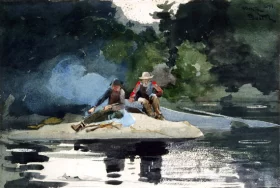
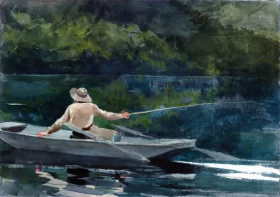
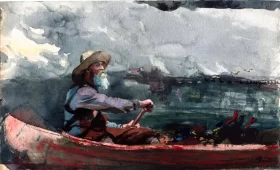
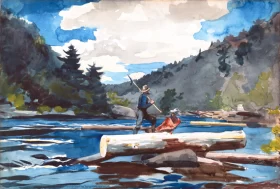
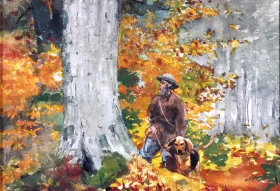
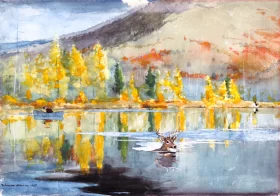
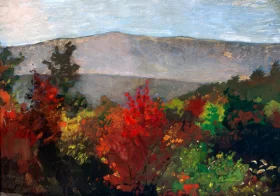
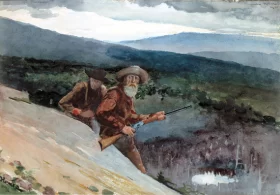
Additionally, Homer found inspiration in a number of summer trips to the North Woods Club, near the hamlet of Minerva, New York in the Adirondack Mountains. It was on these fishing vacations that he experimented freely with the watercolor medium, producing works of the utmost vigor and subtlety, hymns to solitude, nature, and to outdoor life. Homer doesn’t shrink from the savagery of blood sports nor the struggle for survival. The color effects are boldly and facilely applied. In terms of quality and invention, Homer’s achievements as a watercolorist are unparalleled: «Homer had used his singular vision and manner of painting to create a body of work that has not been matched.»
In 1893, Homer painted one of his most famous «Darwinian» works, The Fox Hunt, which depicts a flock of starving crows descending on a fox slowed by deep snow. This was Homer’s largest painting and it was immediately purchased by the Pennsylvania Academy of the Fine Arts, his first painting in a major American museum collection. In Huntsman and Dogs (1891), a lone, impassive hunter, with his yelping dogs at his side, heads home after a hunt, with deer skins slung over his right shoulder. Another late work, The Gulf Stream (1899), shows a Black sailor adrift in a damaged boat, surrounded by sharks and an impending maelstrom.
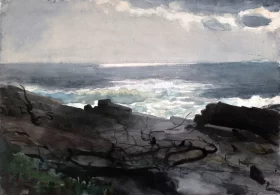
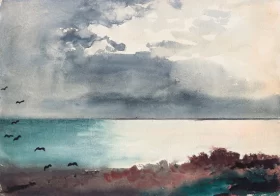
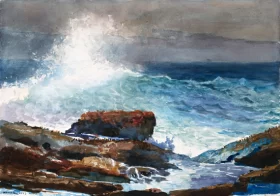
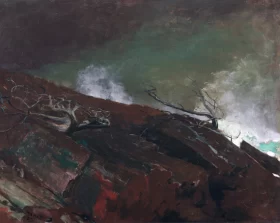
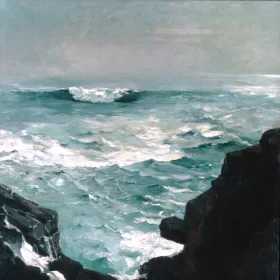
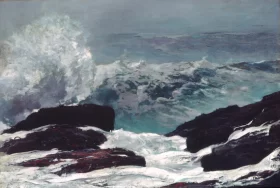
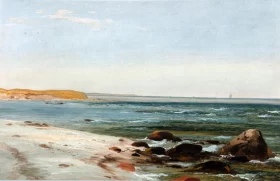
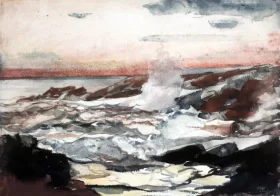
By 1900, Homer finally reached financial stability, as his paintings fetched good prices from museums and he began to receive rents from real estate properties. He also became free of the responsibilities of caring for his father who had died two years earlier. Homer continued producing excellent watercolors, mostly on trips to Canada and the Caribbean. Other late works include seascapes absent of human figures, mostly of waves crashing against rocks in varying light. In his last decade, he at times followed the advice he gave a student artist in 1907, «Leave rocks for your old age-they’re easy».
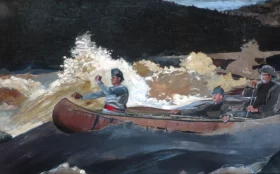
Homer died in 1910 at the age of 74 in his Prout’s Neck studio and was interred in the Mount Auburn Cemetery in Cambridge, Massachusetts. His painting, Shooting the Rapids, Saguenay River, remains unfinished.
His Prout’s Neck studio is now owned by the Portland Museum of Art.
Read moreViser 201–300 av 552 resultater

The Sloop «Kulinda» 1880
By Winslow HomerSizes starting at kr2.859
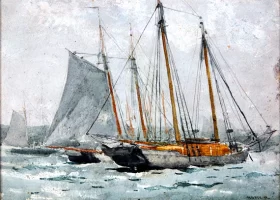
Three Schooners at Anchor, Gloucester, 1880
By Winslow HomerSizes starting at kr2.829
Two Boys Rowing, Gloucester 1880
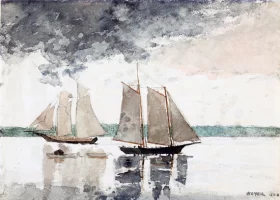
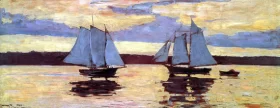
By Winslow HomerSizes starting at kr2.859Two Schooners, 1880
By Winslow HomerSizes starting at kr2.829
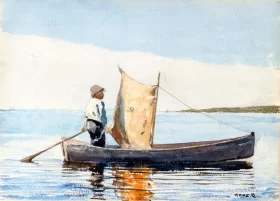
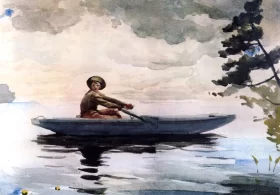
Boy in a Dory 1881
By Winslow HomerSizes starting at kr2.939
English Coastal Scene, 1878
By Winslow HomerSizes starting at kr2.889
Gloucester Harbor and Dory, 1880
By Winslow HomerSizes starting at kr2.889
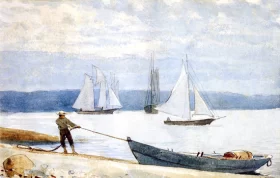
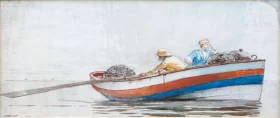
Pulling the Dory, 1880
By Winslow HomerSizes starting at kr3.069
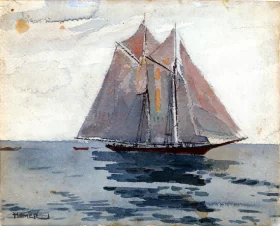
Gloucester Schooner 1880
By Winslow HomerSizes starting at kr2.719
Boy on a Raft, 1879
By Winslow HomerSizes starting at kr3.109
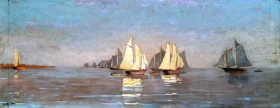
Sailing calm water 1880
By Winslow HomerSizes starting at kr2.989
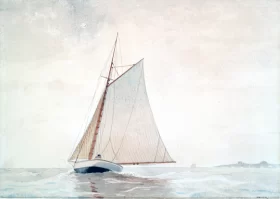
Sailing off Gloucester 1880
By Winslow HomerSizes starting at kr2.899
Storm on the English Coast, 1883
By Winslow HomerSizes starting at kr2.889The Boatman 1891
By Winslow HomerSizes starting at kr2.929
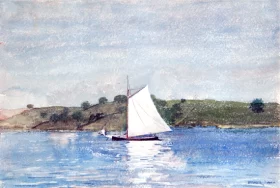
Yacht in a cove, Gloshester, 1880
By Winslow HomerSizes starting at kr2.799
Two Sailboats 1880
By Winslow HomerSizes starting at kr2.859
Winding Line 1874
By Winslow HomerSizes starting at kr2.909
Fisherman and Girl in a Rowboat Streaked Red, White and Blue 1881
By Winslow HomerSizes starting at kr3.789
Mackerel Fleet at Dawn, 1884
By Winslow HomerSizes starting at kr4.019Mackerel Fleet at Dawn, 1884
By Winslow HomerSizes starting at kr4.019
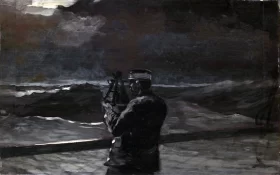
Taking an Observation, 1884
By Winslow HomerSizes starting at kr3.029On the Beach 1869
By Winslow HomerSizes starting at kr3.029
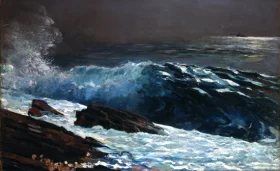
Sunlight on the Coast 1890
By Winslow HomerSizes starting at kr3.079Northeaster 1895
By Winslow HomerSizes starting at kr2.959
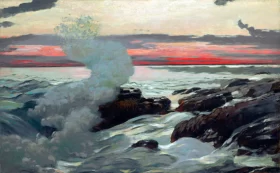
West Point, Prout’s Neck 1900
By Winslow HomerSizes starting at kr3.059
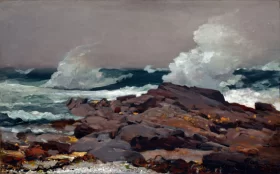
Eastern Point 1900
By Winslow HomerSizes starting at kr3.059
Moonlight, Wood Island Light 1894
By Winslow HomerSizes starting at kr2.809Sunshine and Shadow, Prout’s Neck 1894
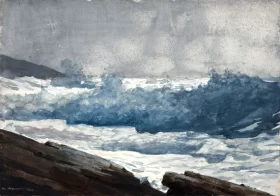
By Winslow HomerSizes starting at kr2.929Breaking Storm, Coast of Maine 1894
By Winslow HomerSizes starting at kr2.859Incoming Tide, Scarboro, Maine, 1883
By Winslow HomerSizes starting at kr2.929
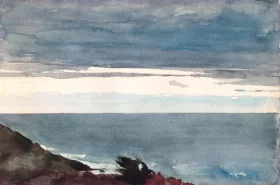
Early Morning After a Storm at Sea
By Winslow HomerSizes starting at kr3.159
Coast of Maine 1893
By Winslow HomerSizes starting at kr2.689High Cliff, Coast of Maine, 1894
By Winslow HomerSizes starting at kr2.749
On a Lee Shore 1900
By Winslow HomerSizes starting at kr2.429
Winter Coast 1890
By Winslow HomerSizes starting at kr2.569Cannon Rock 1895
By Winslow HomerSizes starting at kr2.429Maine Cliffs 1883
By Winslow HomerSizes starting at kr2.889Prout’s Neck, Breaking Wave 1887
By Winslow HomerSizes starting at kr2.929Maine Coast 1896
By Winslow HomerSizes starting at kr2.989
Maine Coast
By Winslow HomerSizes starting at kr3.039
Coast in Winter, 1892
By Winslow HomerSizes starting at kr3.169
Summer Squall 1904
By Winslow HomerSizes starting at kr2.689Prout’s Neck, Surf On Rocks, 1895
By Winslow HomerSizes starting at kr2.929Prout’s Neck, Breakers 1883
By Winslow HomerSizes starting at kr2.859
Prout’s Neck, Evening 1894
By Winslow HomerSizes starting at kr2.939
Prout’s Neck Surf 1894
By Winslow HomerSizes starting at kr2.969
Rocky Coast and Gulls 1869
By Winslow HomerSizes starting at kr3.199
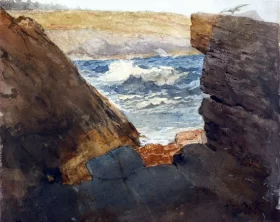
Through the Rocks, 1883
By Winslow HomerSizes starting at kr2.749The Northeaster 1883
By Winslow HomerSizes starting at kr2.859
View at Prout’s Neck, Maine, 1894
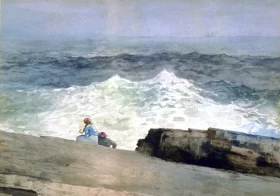
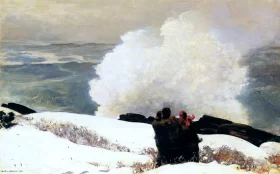
By Winslow HomerSizes starting at kr2.999Watching the Breaker – A High Sea 1896
By Winslow HomerSizes starting at kr3.059
Surf, Prout’s Neck 1883
By Winslow HomerSizes starting at kr3.139
Surf at Prout’s Neck, 1895
By Winslow HomerSizes starting at kr3.229
Sandy Beach with Breakers
By Winslow HomerSizes starting at kr3.589
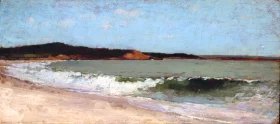
Study for Eagle Head, Manchester, Massachusetts 1869
By Winslow HomerSizes starting at kr3.709
Tynemouth Beach, 1883
By Winslow HomerSizes starting at kr5.039
The Trapper 1870
By Winslow HomerSizes starting at kr3.069Building a smudge 1891
By Winslow HomerSizes starting at kr3.109
Casting, Number Two 1894
By Winslow HomerSizes starting at kr2.969Fishing in the Adirondacks, 1889
By Winslow HomerSizes starting at kr2.999Fishing In the North Woods 1896
By Winslow HomerSizes starting at kr2.969A quiet pool on a sunny day 1889
By Winslow HomerSizes starting at kr3.099
Adirondacks Guide 1892
By Winslow HomerSizes starting at kr3.219
An Unexpected Catch 1890
By Winslow HomerSizes starting at kr3.279
Hound and Hunter, 1892
By Winslow HomerSizes starting at kr3.339
Hudson River, Logging
By Winslow HomerSizes starting at kr3.039Hunting Dogs in Boat, 1889
By Winslow HomerSizes starting at kr3.049Sketch for «Hound and Hunter»
By Winslow HomerSizes starting at kr2.999The End of the Day, Adirondacks 1890
By Winslow HomerSizes starting at kr3.049The End of the Hunt 1892
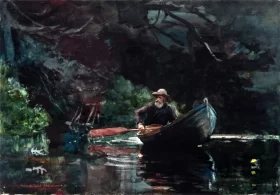
By Winslow HomerSizes starting at kr2.969The Guide, 1889
By Winslow HomerSizes starting at kr2.999
The Eagle’s Nest 1902
By Winslow HomerSizes starting at kr3.129The Guide, 1895
By Winslow HomerSizes starting at kr3.049The Rise, 1900
By Winslow HomerSizes starting at kr3.069The North Woods, 1884
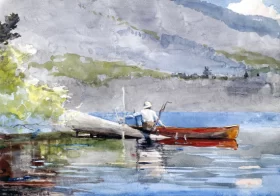
By Winslow HomerSizes starting at kr2.969The Red Canoe 1889
By Winslow HomerSizes starting at kr3.049Trappers Resting 1874
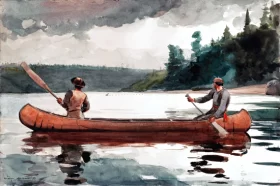
By Winslow HomerSizes starting at kr2.969Young Ducks 1897
By Winslow HomerSizes starting at kr3.069Canoe in Rapids, 1897
By Winslow HomerSizes starting at kr3.069
Ile Malin 1897
By Winslow HomerSizes starting at kr3.069
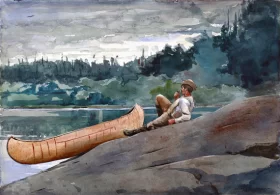
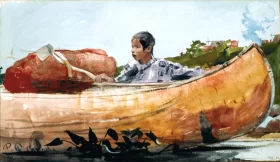
Indian Boy with Canoe, 1895
By Winslow HomerSizes starting at kr3.309Indian Camp, Roberval, P.Q. 1895
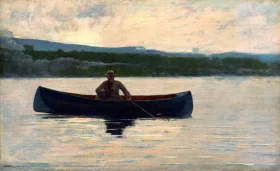
By Winslow HomerSizes starting at kr3.049Playing a Fish 1875
By Winslow HomerSizes starting at kr3.219Shooting the Rapids, Saguenay River
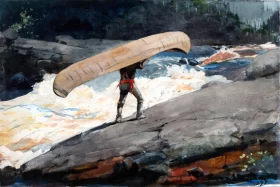
By Winslow HomerSizes starting at kr3.189The Portage 1897
By Winslow HomerSizes starting at kr3.069End of the Portage 1897
By Winslow HomerSizes starting at kr3.069
Sunrise, Fishing in the Adirondacks, 1892
By Winslow HomerSizes starting at kr3.099
A Good Pool, Saguenay River 1895
By Winslow HomerSizes starting at kr3.559Adirondack Lake 1889
By Winslow HomerSizes starting at kr2.999Under the Falls, the Grand Discharge, 1895
By Winslow HomerSizes starting at kr2.999A Good One, Adirondacks, 1889
By Winslow HomerSizes starting at kr3.159After the Hunt 1892
By Winslow HomerSizes starting at kr3.049A Fisherman’s Day, 1889
By Winslow HomerSizes starting at kr3.179A Good Shot, Adirondacks, 1892
By Winslow HomerSizes starting at kr2.969A Huntsman and Dogs 1891
By Winslow HomerSizes starting at kr3.279Adirondack woods, Guide and Dog, 1889
By Winslow HomerSizes starting at kr3.039An October Day 1889
By Winslow HomerSizes starting at kr2.969Autumn Treetops, 1873
By Winslow HomerSizes starting at kr3.049Bear Hunting, Prospect Rock, 1892
By Winslow HomerSizes starting at kr2.999Campfire, Adirondacks 1892
By Winslow HomerSizes starting at kr2.969